
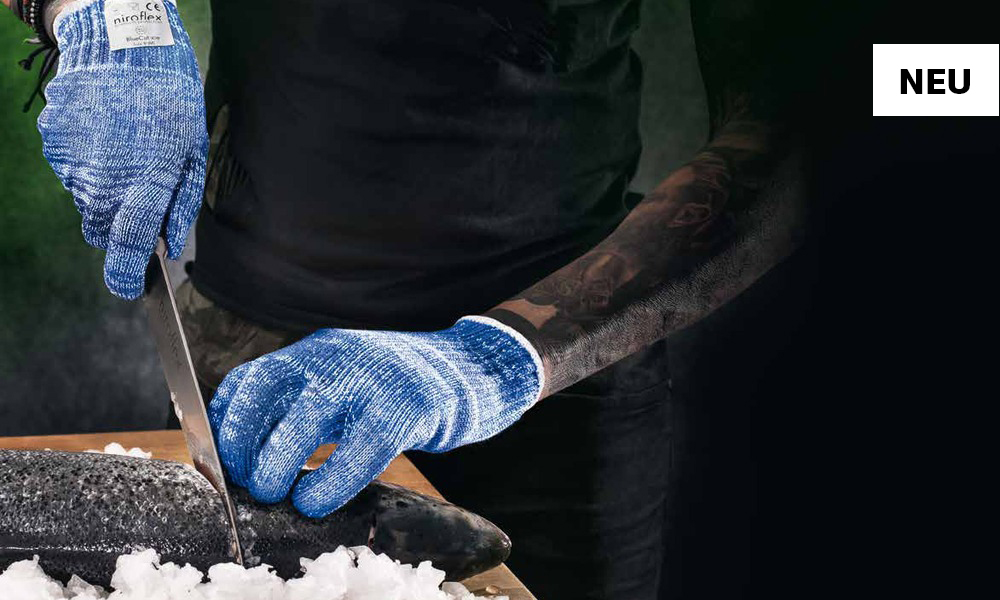
In meat processing, hand protection has been standard practice for years. With fish, it’s often lumped in as an afterthought to meat processing. That’s a mistake. Wet, cold work surfaces, slippery scales and skin, plus very thin, extremely sharp filleting knives: classic cut-protection concepts from meat processing don’t simply transfer over.
Why Does Fish Processing Have Different Cut-Protection Requirements?
Anyone who has stood at a filleting line knows: hands are wet almost constantly, often chilled further by ice or cold processing rooms. That changes tactile sensitivity, and with it, how secure a glove feels and how reliably it can be handled. Add to that the time pressure in paced operations, where many similar hand movements happen in quick succession.
The knives themselves are different from those used in meat processing, too. Filleting knives are thin, flexible, and ground very sharp so they can cut cleanly along the bones. Great for the job, risky for the hand next to it if the blade slips.
Typical Injury Risks: Filleting, Deboning, Portioning, Cleaning
The risk points in the workflow are easy to name:
- Filleting: the knife runs along the spine, often with the supporting hand right next to the blade
- Deboning: fine, precise movements, frequently with tweezers or small blades close to the fingers
- Portioning: many similar cuts in a row, fatigue increasing toward the end of a shift
- Cleaning equipment and work surfaces
This last point is often overlooked in practice, yet a significant share of cut injuries happen not during actual processing but during cleaning and changeovers, away from the step people first think of when it comes to hand protection.
Another commonly missed factor: inadequate PPE. Personal protective equipment has to match the remaining hazards exactly. If it doesn’t, a residual risk stays in place despite the glove, one that often only shows up late in the risk assessment.
Which niroflex Cut Protection Level Makes Sense for Fish Processing?
There’s no blanket answer here, and that’s a good thing. For rough cutting steps involving a lot of force, a higher cut protection level can make sense; for fine filleting work, tactile sensitivity often matters more, since a glove that’s too stiff makes knife control harder and creates new risks. We’ve already explained in detail how the test methods and cut protection levels are structured: The same principle applies to fish processing: the right level follows from the specific task, not from a blanket maximum value.
What Matters in Gloves for Wet, Hygiene-Sensitive Environments?
We’ve already summarized which properties a glove for damp, food-processing areas should generally have: . For fish processing, there are a few extra factors that don’t come into play in the general case:
- Grip on scaly surfaces: fish scales and skin behave differently under the hand than smooth meat. A coating that works well on meat won’t necessarily grip the same way on fish.
- Tactile sensitivity in the cold: fish is often processed at lower temperatures than meat. The glove has to allow fine knife work at the filleting station even after hours in a cold environment.
- Combining with cut protection: moisture protection alone, like the , usually isn’t enough here. What’s needed is a product that brings both properties together at once.
That’s exactly where it’s worth looking at our niroflex glove types and , both already built for use in meat and fish processing.
Care & Hygiene in Daily Work
In an environment this wet and hygiene-sensitive, proper care largely determines how long the equipment lasts. Between a glove that needs replacing after a few weeks and one that reliably protects for months, the difference is often not the material. It comes down to how it’s handled day to day. We’ve summarized how to properly clean, dry, and check protective gloves for wear in wet areas of food production here:
Frequently Asked Questions About Gloves in Fish Processing
Is cut protection level 5 enough for fish processing?
For many tasks, yes, for some it’s even more than needed. The deciding factor is the specific task: for rough cutting, a high level can make sense; for fine filleting work, tactile sensitivity often matters more than the maximum protection value.
Are cut-resistant gloves for fish processing automatically waterproof?
No, and that surprises a lot of people. Cut protection and waterproofing are two independent properties: a glove can offer very good cut protection and still let moisture through. At wet workstations, it’s worth taking a closer look at coating and material construction, not just the cut protection level.
How often should gloves be replaced in fish processing?
There’s no reliable fixed timeframe, it depends too much on wear and cleaning frequency. Regular visual inspections are more reliable: holes, frayed spots, or a coating that’s wearing thin say more than any rigid replacement interval.
Need help choosing the right cut-resistant gloves for your fish processing operation? or download our product catalog.