

With cut protection, most people check the class or the Newton value first. With cold protection, it’s the opposite: everyone has heard of EN 511, but hardly anyone knows what the numbers behind it actually mean. That code decides whether a glove really protects in a cold store or when handling deep-frozen goods, or just looks like it does.
What does EN 511 mean for gloves?
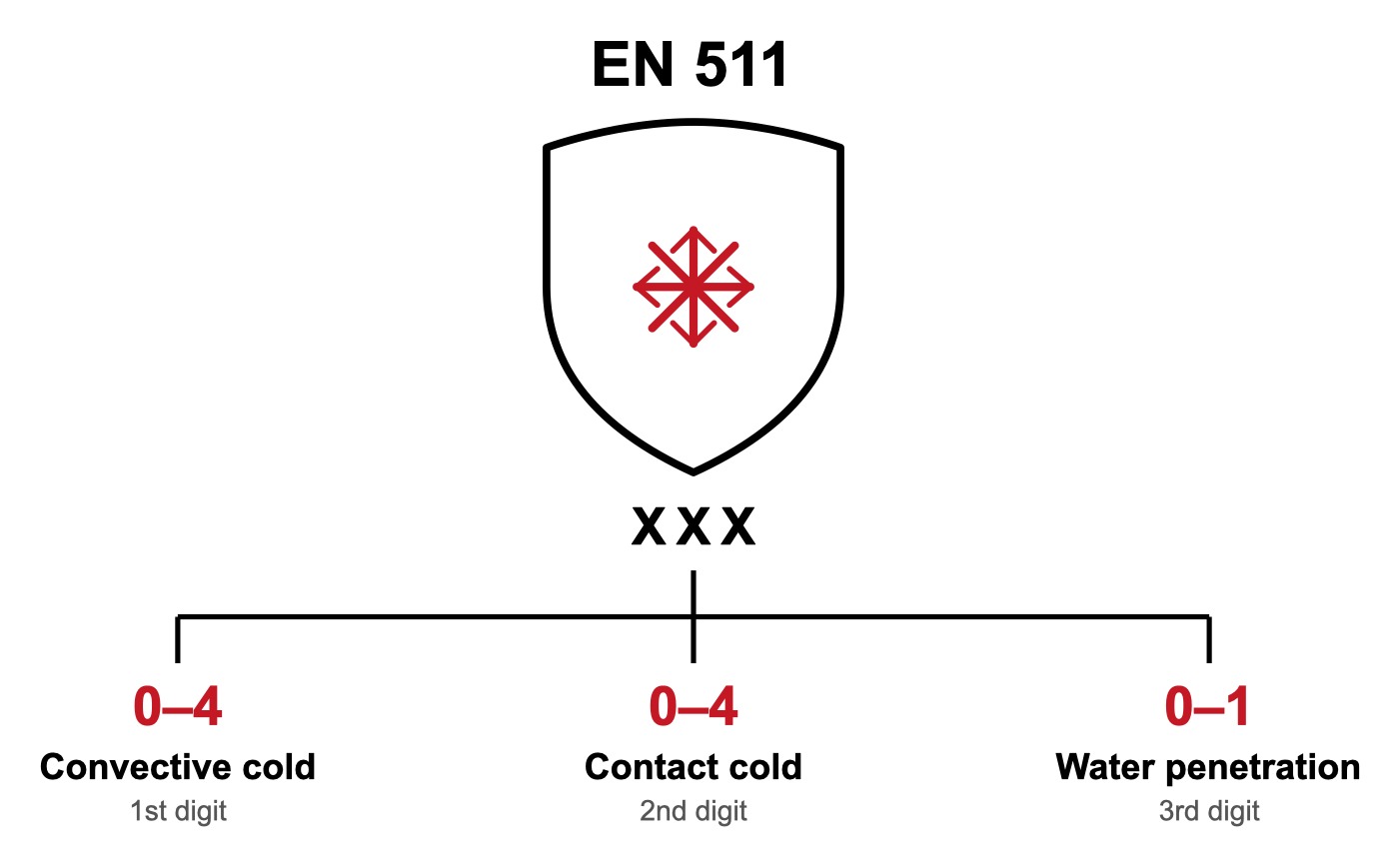
EN 511 is the European standard for gloves designed to protect against cold. Unlike cut protection, there’s no single class from 1 to 5. Instead there’s a three-digit code that describes three independent properties: insulation against cold moving air, insulation against direct contact with cold surfaces, and whether the glove lets water through. Each digit stands for one of these values, independent of the other two. A glove can score very well on one property and poorly on another.
The three EN 511 ratings
- Convective cold (first digit, scale 0–4): Measures insulation against cold, moving air. In the test, a heated artificial hand wearing the glove is placed in a climate chamber set considerably colder than the hand’s temperature. The test measures how much energy is needed to keep the hand’s temperature between 30 and 35 °C. The less energy required, the higher the digit.
- Contact cold (second digit, scale 0–4): Rates thermal resistance on direct contact with cold surfaces, such as a frozen pallet or a metal table. A material sample is measured between two plates at different temperatures. Again, a higher digit means better protection.
- Water penetration (third digit, scale 0 or 1): A simple pass/fail test. The glove is submerged in water for 30 minutes. If it stays watertight, it gets a 1, otherwise a 0.
How do you read the EN-511 code?
An example: “EN 511: 231” means convective cold 2, contact cold 3, water penetration 1. That’s a glove with medium air insulation, good contact-cold insulation, and a watertight construction. An X often appears instead of a digit, for instance in “X2X”. An X is not a failing grade. It shows that this property wasn’t tested or doesn’t apply to the construction: a plain knitted glove without a membrane usually isn’t tested for water penetration at all, because the material isn’t watertight by design. The digit is left out rather than scored as a 0.
What does this mean for gloves like BlueCut ice or BlueShell ice?
At niroflex, the difference between EN 511 ratings shows up directly in the range: BlueCut ice is rated X2X and combines cold insulation with cut protection level F under EN ISO 13997 (49 N). We’ve explained how that classification works in detail here: What Does Cut Protection Level 5 Mean? BlueShell ice sits slightly below that at X1X, but scores well on tactile sensitivity and also works as a glove liner. The BlueShell ice dots variant adds grip-enhancing PVC dots and is rated down to -20 °C contact cold.
Important: a high EN 511 rating says nothing about cut protection, and the other way round. If you need both, for example in meat or fish processing where cold and sharp blades come together, you’ll find a practical example in our article on fish processing. There, moisture plays a role alongside the cold, which EN 511 covers through its third digit, but only as a simple pass/fail value.
What should you look for when choosing EN 511 gloves?
The ratings are a good starting point, but not the whole decision. How long and how continuously someone works in the cold makes a difference: a quick trip into a cold store needs different values than a full shift there. The type of cold matters too. Dry freezer air makes different demands than the wet cold of contact with ice, as found in fish processing or cleaning work. For cases like that, it’s worth looking beyond EN 511, for example at our article on protection for wet working environments in food production.
And finally, the best rating helps little if dexterity suffers. Especially for fine motor tasks in the cold, a glove that insulates well but hinders precise work is often the worse choice in practice.
Frequently asked questions about EN 511
Is a higher EN 511 rating automatically the better choice?
Not necessarily. High convective-cold insulation usually means more material, and less tactile feel. For short, fine-motor tasks, a lower rating with better mobility can be the more practical solution than the maximum protection value.
What does an X mean in the EN 511 code?
An X is not a failing grade. It shows that this property wasn’t tested or doesn’t apply to the glove’s construction, for example water penetration on an open-knit glove. A 0 would be a poor test result; an X means simply that no test was carried out.
Does a cold protection glove automatically offer cut protection too?
No. EN 511 and the cut protection standards such as EN 388 or EN ISO 13997 test completely independent properties. A glove can insulate excellently and still offer no cut protection at all. If you need both, look specifically for products designed and certified for both requirements.
Need help choosing the right cold protection gloves? Contact us directly or download our product catalogue.