
FAQ – Frequently Asked Questions
In this section, you will find the most important information about our products, their application, and care. The FAQs will help you quickly find answers to our customers’ most frequently asked questions.
In this section, you will find the most important information about our products, their application, and care. The FAQs will help you quickly find answers to our customers’ most frequently asked questions.
Products made of ring mesh must be cleaned immediately after use with warm water, approx. 50° C, with the addition of cleaning agents commonly used in the butchery and food industry, by vigorous brushing. Very good cleaning is also achieved if the gloves or aprons are washed in a normal and/or customary washing machine. After the product has dried, it must be sprayed with a disinfectant commonly used in the food industry (leave to act for a few minutes). After cleaning, store the products in a dry, cool and well-ventilated place. It’s important to ensure that only disinfectants commonly used in the food industry are used. Disinfectants with excessive chlorine and acid content can damage products.

Gloves should not be worn too tight, as this restricts flexibility and wearing properties. For a comfortable fit, 5mm can be added to the circumference. If a cotton glove or under glove is worn under the ring mesh glove, a further 3 mm circumference is added.
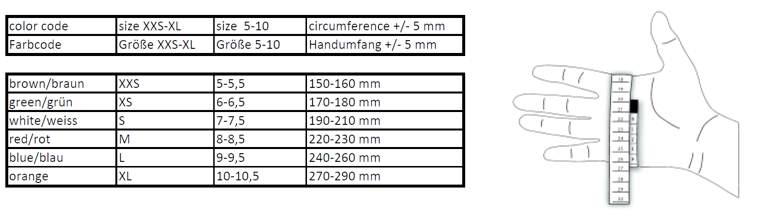
Please refer to the information in the size chart on the product page
Please refer to the information in the size chart on the product page
Protective aprons and gloves may only be used in the form supplied by the manufacturer. Only in this form do the products comply with national and European requirements. Only faultless products may be used in the work. Necessary repairs may be carried out using original spare parts. A professional repair is only guaranteed in this case. With the original niroflex repair service, we help unbureaucratically and professionally with problems with CE-compliant products made of ring mesh.
brown = XXS, green = XS, white = S, red = M, blue = L, orange = XL, olive = XXL
Internationale sales partner: Distribution
National = regional sales partner
Available upon request
ISO 9001
No – exception: easyfit can be used to a limited extent
When using extremely sharp knives, Ø 4.2 mm is recommended. Otherwise Ø 7.0 mm
Most products are available from stock. Orders from our standard range leave our shipping center on the same day.
Customization feasible for people and applications. We develop ideas and products together with our customers and create tailor-made solutions, application-oriented down to the smallest detail.
Washing and care instructions
Wash the cut resistant gloves with a normal wash cycle at no more than 85°C (185°F). A spin cycle will reduce the drying time. When using a dryer, do not exceed the max. temperature of 70°C (160°F) or 10 minutes’ drying time. The gloves must be stored in a dry place.
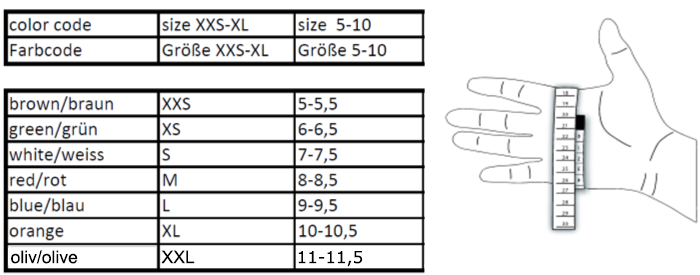
niroflex cut resistant gloves offer a high resistance to cuts and abrasion, but do not protect against punctures. The gloves must not be used in the vicinity of power blades, knives, saws, or similar tools.
The gloves generally do not bother the skin and should not cause allergic reactions when a commercially available detergent is used
Only faultless niroflex BlueCut gloves may be used during work. The buyer and/or users are responsible for the correct use of the gloves. The manufacturer and/or seller do not assume any liability or guarantee.
There is no guarantee that the specified performance levels will be guaranteed after more than 20 wash cycles.
brown = XXS, green = XS, white = S, red = M, blue = L, orange = XL, olive = XXL
Internationale sales partner: Distribution
National = regional sales partner
10 pieces per size
No
Used gloves must be disposed of in accordance with the disposal regulations for pollution and the regulations of the local authority.
Unused gloves can be disposed of with household waste.
Most products are kept in stock.
Coupe test (EN 388:2003) remains a part of EN 388:2016. As an additional cutting test, the test method from ISO 13997 was integrated into the current EN 388. This test is more informative than the previous Coupe test, as the force actually measured when cutting is given in newtons (N). The cut protection classes are classified by coding the letters A through F, with A (2 N) representing the lowest and F (30 N) the highest performance levels.
100 years of technical experience in connection with critical work areas is the basis for supporting our dealers and their customers in choosing the right product for their requirements. We are always available to answer your questions.
One allergic reaction caused by gloves is the reaction to nitrile proteins and/or additives used in the manufacture of gloves. While most allergies generally show mild symptoms, a very small percentage may lead to serious reactions.
We recommend a glove with a certain cuff length (approx. 40.5 cm) if protection up to the elbow is desired. Also suitable for pulling over armguards.
When using hand knives, wear the cut-resistant gloves on the hand holding the item being cut and on the hand holding the knife.
All of our gloves are suitable for use in food processing and/or food manufacturing.
The European standard DIN EN 388: 2003 describes the requirements, test methods, and markings required of protective gloves with regard to physical and mechanical loads when carrying out work. This standard applies together with the basic standard DIN EN 420. The mechanical risks and loads and their test methods are defined in DIN EN 388:2003 as follows: abrasion resistance; cut resistance; tear strength; puncture resistance.
Abrasion resistance is determined as the number of cycles required until the surface of the glove is penetrated. Penetration occurs when the test specimen is worn to the point that a hole has appeared.
The cut resistance value is based on the number of test cycles required to cut the test glove with a fixed load (5N) at a constant speed.
Tear resistance is defined as the force which is required to tear a crack in a rectangular test specimen over half its length.
The piercing force is defined as the force that is required to puncture a test specimen attached to a holding device with the aid of a steel pin with specified dimensions. This should not be confused with perforation using thin tips or needles.
The protective function against mechanical injuries is shown with a pictogram and five digits. These indicate the respective performance levels.

The previous cut protection test for cut protection gloves is carried out using the so-called coupe test. A rotating circular knife moves back and forth on the test item with a defined force (5N) and rotates in the opposite direction to the movement. The sharpness of the blade is measured using a reference tissue at the beginning of the test and at the end of the test. The wear on the blade can thus be determined and taken into account. The index value shows the number of cycles required to cut through the test specimen and the degree of wear on the blade used.
In the test procedure according to ISO 13997, the durability of the glove against a sharp-edged object is determined in the event of a single contact with greater force. To do this, a long straight blade is moved once over the test item. The minimum force to the cross-section of the test piece after 20 millimeters is determined. The result is given in newtons (N) which is then used to determine the cut protection class of the specimen.
The gloves certified under DIN EN 511 are intended to protect the wearer from both convection cold (penetrating cold) and contact cold (direct contact). The individual aspects are classified into different performance levels. The performance levels are indicated with a number from 1 to 4 next to the pictogram, with 4 describing the highest performance level.
Protective gloves that are certified in accordance with the DIN EN 407 standard protect the wearer, for example, from contact and/or radiant heat. The protective gloves are classified and tested according to the following criteria: Protection against ignition; Protection against contact heat; Protection against convection heat.
If you have any additional questions about our products, applications, or safety standards, our service team is always available to assist you. Whether you need technical details, customized solutions, or advice on the right product selection, we will help you quickly and reliably.